5.0 Google Rating See our reviews ↗
Medicaid CAS PHC / FC / CAS Programs
Veterans Care Coordination VA Benefits Accepted
Caring.com Senior Care Resource
AgingCare.com Caregiver Community
A Place for Mom Senior Living Advisor
CareScout Care Finder Network
5.0 Google Rating See our reviews ↗
Medicaid CAS PHC / FC / CAS Programs
Veterans Care VA Benefits Accepted
Caring.com Senior Care Resource
AgingCare.com Caregiver Community
A Place for Mom Senior Living Advisor
CareScout Care Finder Network
Home Care vs. Assisted Living in Houston TX — Honest 2026 Comparison | CareWorks Houston
📋 2026 Houston Family Guide

Home Care vs. Assisted Living in Houston — An Honest Comparison

This guide doesn’t try to sell you one option over the other. It gives you the real 2026 Houston-area cost data, the quality-of-life factors most guides skip, and a clear framework for making the right decision for your family — whichever way that points.

✓ Real 2026 Houston pricing ✓ Medicaid coverage compared ✓ Decision framework included ✓ No sales pitch
Senior with family caregiver at home in Greater Houston area, reviewing options for care
RA
Ruby Agrawal
Licensed Home Care Administrator · CareWorks Houston
Updated June 2026 · Houston, TX

The Honest Guide Houston Families Actually Need

Most comparisons between home care and assisted living are written by someone who profits from one of the two options. An assisted living marketing site will tell you home care is isolating and unsafe. A home care agency site will tell you assisted living is cold and impersonal. Neither is particularly useful when you’re trying to make one of the most consequential decisions of your family’s life.

This guide is written by CareWorks Houston — a home care agency. We have an obvious interest in home care. We’re disclosing that upfront. And we’re also telling you directly: assisted living is the right choice in some situations. We’ll tell you exactly when, with the same specificity we use to describe when home care is the better fit. Our goal is for your loved one to receive the right care — not necessarily our care.

What follows is a genuine comparison using 2026 Houston-area pricing data, research on quality of life outcomes, an honest look at what Medicaid actually covers under each option in Texas, and a practical framework for working through the decision. Read the whole thing, or jump to the section most relevant to your situation.

⚠️ A note on this guide’s source

CareWorks Houston is a licensed in-home care agency. We benefit when families choose home care. We’ve made every effort to present this comparison fairly and accurately, but you should weigh that context. For a genuinely independent view, consider also consulting your loved one’s physician, a geriatric care manager, or a hospital social worker before making a decision.
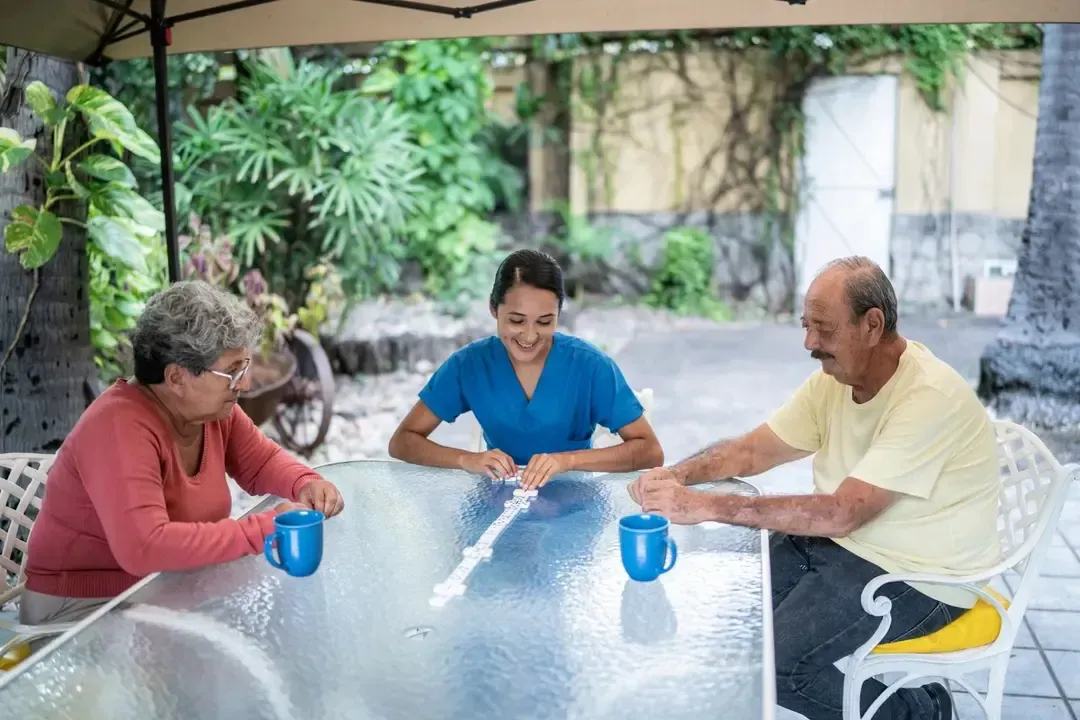
CareWorks caregiver with senior at home in Sugar Land Texas — in-home care option

What Each Option Actually Costs in the Houston Area

Costs vary significantly based on hours of care needed, specific neighborhood, and care level required. These are real 2026 Houston-area ranges, not national averages.

Care Situation🏠 In-Home Care (CareWorks)🏢 Assisted Living (Houston area)
Light support
~2–3 hrs/day, a few days/week
$900–$1,800/mo
Ideal for early-stage needs, medication reminders, companionship
Not applicable
Assisted living requires full-time residency regardless of care level needed
Moderate support
~4 hrs/day, 5 days/week
$1,800–$3,200/mo
Most common starting point for families; covers morning routine, meals, safety
$3,800–$5,200/mo
Base monthly rate for standard private room in Houston HHSC-licensed facility
Full-day support
~8 hrs/day, 7 days/week
$3,600–$5,000/mo
Comprehensive daily care while remaining at home; most ADL assistance covered
$4,500–$6,500/mo
Mid-range Houston facilities with meals, activities, and personal care included
Memory care level
Dementia or Alzheimer’s
$3,600–$5,500/mo
Specialized dementia caregiver; may qualify for Medicaid CAS at little/no cost
$5,500–$7,500/mo
Memory care units carry a $1,000–$1,500 premium over standard assisted living
24-hour / overnight
Continuous supervision needed
$7,000–$12,000/mo
Live-in or rotating overnight caregivers; most expensive home care scenario
$5,500–$8,000/mo
Assisted living has cost advantage when true 24-hr supervision is required
With Medicaid (qualifying)$0–$500/mo
Texas PHC/CAS covers substantial or full cost; CareWorks is an approved provider
Limited coverage
STAR+PLUS waiver has waitlists and enrollment caps; not broadly accessible in Houston
Hidden costs to watch forAgency fees, holiday/weekend rates, minimum hour requirementsMove-in fees ($1,000–$5,000+), medication management fees ($200–$500/mo), transport costs, level-of-care escalation fees
The cost crossover point: For families needing fewer than 6–7 hours of care per day, in-home care is typically the more affordable option in the Houston area. When a person genuinely requires continuous 24-hour supervision, assisted living’s all-inclusive monthly rate often becomes more cost-competitive than round-the-clock home care staffing.

A Practical Side-by-Side Comparison

Beyond cost, families want to know what daily life actually looks like under each arrangement — for the person receiving care and for the family supporting them.

🏠 In-Home Care

Support comes to your loved one — in the home they know

Stays in familiar home, neighborhood, and community
One-to-one caregiver attention — not shared with 20 other residents
Family can visit anytime without facility visiting hours
Care schedule built around the person’s existing routines
Medicaid CAS covers cost for many qualifying Houston families
Pets, personal belongings, and home environment stay intact
Flexible — start with a few hours and increase as needs grow
⚠️Household maintenance (lawn, repairs) still falls to family
⚠️Social activities require deliberate scheduling outside the home
⚠️24-hour home care is expensive and logistically complex

🏢 Assisted Living

Your loved one moves into a care community

Built-in social programming and peer community
Meals, housekeeping, and activities included in one monthly fee
24-hour staffing without the cost of round-the-clock private caregivers
Eliminates household maintenance burden for family
Emergency response available at any hour
⚠️Requires leaving home, neighborhood, and familiar surroundings
⚠️Care is shared across many residents — less individualized attention
⚠️Facility rules govern daily schedule, meals, and activities
⚠️Pets usually not permitted; personal belongings limited by room size
⚠️Texas Medicaid coverage is limited; most costs are private-pay

When Each Option Is Genuinely the Better Choice

This is the section most home care guides skip. We’re not skipping it. Assisted living is the right choice for some families, and we’d rather help you make the right decision than the one that benefits us.

🏠 Choose In-Home Care When…

  • Your loved one’s care needs are moderate — less than 8–10 hours of daily support
  • They have a strong attachment to their home, neighborhood, or community that genuinely sustains their wellbeing
  • They have dementia or Alzheimer’s and respond better to familiar environments (most do)
  • Family members want to remain actively involved in daily care and oversight
  • They qualify for Texas Medicaid CAS — making home care little or no cost
  • A pet, garden, or home-based routine is central to their quality of life
  • Their home can be safely adapted with grab bars, ramps, or layout modifications
  • They have a strong preference to stay home — and that preference is realistic given their care needs

🏢 Choose Assisted Living When…

  • True 24-hour supervision is needed and round-the-clock home staffing is financially or logistically unmanageable
  • Significant social isolation has become a genuine health concern — and the person would thrive with peer community
  • The home environment cannot be safely adapted for their mobility or medical needs
  • A couple has divergent care needs that cannot be met simultaneously at home
  • The family caregiver has reached genuine burnout with no relief available — even with home care support
  • The person themselves genuinely prefers a community setting and expresses this clearly
  • Late-stage dementia with severe behavioral symptoms requires specialized 24-hour memory care
  • The person’s primary physician recommends facility care based on medical complexity

The most important thing we can tell you

The right answer depends entirely on your loved one’s specific situation — their health, their personality, their preferences, their home environment, and your family’s capacity. A geriatric care manager, hospital social worker, or your loved one’s primary physician can provide an assessment that’s genuinely independent of any financial interest in the outcome. Consider that resource before making a final decision.

What Texas Medicaid Actually Covers — Under Each Option

Medicaid coverage is one of the most significant — and most misunderstood — factors in this decision for Houston families. Here’s an honest breakdown of what each option looks like under Texas Medicaid in 2026.

🏠 Medicaid Coverage for In-Home Care

Texas PHC (Personal Home Care) and CAS (Community Attendant Services) programs cover personal care and daily living assistance at home for qualifying low-income seniors and adults with disabilities. These programs are broadly accessible — CareWorks is an approved HHSC provider.

For many Houston families, Medicaid CAS covers the full cost of home care — meaning your loved one receives professional, trained caregiver support at little or no out-of-pocket expense. Eligibility is based on functional limitations and income/asset thresholds.

The FC (Family Care) program also allows qualifying family members to be paid to provide care — a meaningful option for some Houston families.

Medicaid home care FAQ → full eligibility guide

🏢 Medicaid Coverage for Assisted Living

Standard Texas Medicaid does not broadly cover assisted living. The STAR+PLUS waiver program can cover some assisted living costs for qualifying individuals, but it operates with enrollment caps, waitlists, and managed care organization restrictions in the Houston area.

In practice, most Houston-area families pay for assisted living out of pocket, through long-term care insurance, or through the VA Aid & Attendance benefit if the person is a qualifying veteran or surviving spouse.

This is one of the most significant financial differences between the two options. For a family that qualifies for Medicaid CAS, home care may cost nothing — while assisted living at $4,000–$6,000/month must largely be paid privately.

Veterans Aid & Attendance benefit →

Quality of Life — What the Research Actually Shows

Cost matters, but quality of life matters more. Here’s what research and clinical experience consistently show about how each option affects wellbeing.

🧠 For Dementia & Cognitive Decline

Home care:Familiar environments reduce confusion, agitation, and anxiety. Research consistently supports home as the better environment through early and moderate stages.
Assisted living:Memory care units provide 24-hour specialized supervision. Better suited for late-stage dementia with severe behavioral symptoms requiring continuous clinical oversight.

💙 Social Connection & Loneliness

Home care:Requires deliberate effort to maintain social contact. A good caregiver provides meaningful companionship, but peer community requires planning. Risk of isolation if family isn’t engaged.
Assisted living:Built-in peer community, activities, and social programming. Generally better for individuals who are social by nature and will genuinely engage with community life.

🏡 Autonomy & Personal Preference

Home care:Highest level of autonomy — the person’s home, their schedule, their routines. Especially important for individuals with a strong sense of independence and self-determination.
Assisted living:Community schedules govern meals, activities, and overnight hours. Some autonomy within room and personal choices, but facility rules apply broadly.

👨‍👩‍👧 Family Involvement & Relationships

Home care:Family can visit, participate, and remain deeply involved in daily care. Caregiver serves the family as much as the client. No visiting hour restrictions.
Assisted living:Family visits are welcomed but governed by facility norms. Some families find their relationship with a parent improves when the daily caregiving burden is lifted — allowing visits to be genuinely enjoyable rather than exhausting.

🛡️ Safety & Emergency Response

Home care:A trained caregiver provides direct supervision during care hours. Overnight and weekend safety depends on care plan hours and home modifications. A medical alert device bridges unsupervised hours.
Assisted living:24-hour staffing means someone is always available for emergencies. Strongest safety advantage is for individuals with significant fall risk, nocturnal wandering, or medical instability.

🐾 Pets, Belongings & Environment

Home care:Pets stay. Personal belongings, garden, neighborhood walks, and all the small things that make home feel like home remain intact. This matters more than most clinical frameworks account for.
Assisted living:Most facilities do not allow pets. Personal belongings are limited to what fits in one room. The emotional weight of losing a home environment is real and often underestimated.

Practical Framework

Seven Questions to Work Through Before Deciding

There is no algorithm that spits out the right answer for your family. But these seven questions — worked through honestly — will get you much closer to clarity than any cost table or feature list.

1
How many hours of daily support does your loved one actually need right now?
Under 6 hours per day: home care is almost always the more cost-effective option in Houston. Over 10 hours per day or true 24-hour supervision: the financial case for assisted living strengthens considerably. The honest middle ground (6–10 hours) requires weighing the other factors here.
2
What does your loved one actually want — and how clearly can they express it?
If the person can express a clear preference and has the cognitive capacity to understand the choice, that preference deserves significant weight. A strong desire to stay home is not just emotional — it has genuine clinical implications for wellbeing and treatment compliance. If cognitive decline prevents clear expression, family and physician judgment fills the gap.
3
Can the home be made genuinely safe for their current and near-future needs?
Grab bars, ramp installations, bathroom modifications, stair lifts — many Houston homes can be adapted effectively. If the home structure creates hazards that cannot be reasonably mitigated (extreme split-level design, inaccessible bathroom, unavoidable stair dependency), that changes the calculus meaningfully.
4
Does your loved one qualify for Texas Medicaid CAS?
This question changes everything for many Houston families. If Medicaid CAS covers home care at little or no cost, and assisted living must be paid privately at $4,000–$6,500/month, the financial comparison is not close. Check eligibility — it’s simpler than most families expect. CareWorks helps with this at no charge.
5
Is social isolation already a serious concern?
Loneliness has real health consequences — it is associated with cognitive decline, depression, and increased mortality risk in older adults. If your loved one is genuinely isolated at home and would thrive in a community setting, that social benefit is clinically meaningful and should not be dismissed. If they have regular family contact, neighborhood ties, and a good caregiver relationship, isolation may not be the issue.
6
What is the family caregiver’s honest capacity right now?
Family caregiver burnout is a real medical and human crisis — not a moral failing. If the primary family caregiver is already at or beyond their limit, professional home care support can often provide genuine relief. If the situation has gone past what home care supplementation can address, assisted living may protect both the senior and the family caregiver from a worse outcome.
7
Where is the condition likely to be in 12–18 months?
Progressive conditions like dementia, Parkinson’s, and ALS mean care needs will increase. Starting with home care now doesn’t mean staying there forever — many families use home care through early and moderate stages and transition to assisted living when needs increase. Planning for the trajectory, not just the current moment, leads to better decisions.

What Houston Families Ask When Comparing Options

In 2026, assisted living in the Houston area typically costs between $3,800 and $6,500 per month for a private room in a standard HHSC-licensed facility — with memory care units adding another $1,000–$1,500 per month. In-home care costs depend entirely on hours: part-time support (4 hours/day) typically runs $1,800–$3,200 per month, while full-time daily care (8 hours/day) runs $3,600–$5,000 per month. For families needing moderate support, home care is usually more affordable. When true 24-hour supervision is needed, assisted living’s all-inclusive rate can be more cost-competitive than round-the-clock private staffing.
Texas Medicaid does not broadly cover standard assisted living. The STAR+PLUS waiver can cover some assisted living costs for qualifying individuals, but it has enrollment caps and waitlists in the Houston area. In contrast, Texas Medicaid’s PHC and CAS programs cover in-home personal care much more broadly for qualifying individuals. For a family that qualifies for Medicaid CAS, home care may cost nothing — while assisted living typically costs $4,000–$6,500/month out of pocket. This is one of the most significant financial differences between the two options in Texas. See our Medicaid FAQ for eligibility details.
Assisted living is genuinely better when a senior requires 24-hour supervision that cannot be safely or affordably provided at home, when significant social isolation has become a real health concern, when the home cannot be safely modified for their needs, when a couple has conflicting care needs that cannot be managed simultaneously at home, or when the family caregiver has reached genuine burnout. These are real situations — not failures — and in these cases, assisted living serves the person better than home care with its limitations.
For most people with dementia — particularly in early and middle stages — home care in a familiar environment is not only safe but clinically beneficial. Research consistently shows that familiar surroundings reduce confusion, agitation, and anxiety in people with dementia. With appropriately trained caregivers, thoughtful home safety modifications, and the right hours of supervision, most dementia patients can remain home safely through moderate stages. Late-stage dementia with severe behavioral symptoms or 24-hour wandering risk may require the continuous supervision that memory care facilities provide. See our Dementia Care page for a detailed stage-by-stage breakdown.
Yes — and this is actually the most common path for Houston families. Home care during early and moderate stages of a progressive condition, transitioning to assisted living as needs increase, is a well-established approach. Starting with home care does not lock you into it. CareWorks works with families through whatever portion of that arc we can genuinely help with, and we’re honest when a situation has progressed beyond what in-home care can safely manage.
Three good sources for genuinely independent guidance: (1) A geriatric care manager — a licensed professional who assesses care needs and recommends options without financial interest in either direction. (2) A hospital social worker or discharge planner — particularly if your loved one has had a recent hospitalization. (3) Your loved one’s primary care physician or specialist — who can assess the medical complexity and supervision needs that drive the decision. The Area Agency on Aging serving Houston (BakerRipley) can also connect you with free counseling on senior care options.

More Guides on CareWorks Houston

These resources go deeper on specific aspects of the home care decision — costs, Medicaid eligibility, post-hospital transitions, and condition-specific care planning.

Still Not Sure Which Option Is Right?

Our free in-home assessment is genuinely no-pressure. A CareWorks care coordinator visits your loved one’s home, reviews their current needs, and gives you an honest view of whether in-home care is the right fit — or whether a different path makes more sense. We’d rather help you make the right decision than the wrong one.

Free — No Obligation Medicaid Eligibility Checked Honest Assessment Same-Week Scheduling Serving Greater Houston Since 2006

Mon–Fri 9am–9pm · Sat 10am–5pm · Sun 11am–8pm

📍 Serving Greater Houston Caregiver?-- Build your profile on careworks.biz → 832-237-2273